Showing posts with label photography. Show all posts

Tuesday, May 10, 2022

Sensor Showdown

I previously wrote about camera sensors – how they work, sensor size, and a comparison of various sensors in cameras that I’ve owned plus a couple that I haven’t. What I didn’t do there was directly compare photos from my cameras. I suspect that at web publication size it’s going to be difficult to tell the difference, but let’s find out.

I found a couple pairs of pictures among my thousands of photos of similar, though not exactly the same, scenes, taken by 1) the Fujifilm FinePix XP55 (point and shoot) vs. the Canon Rebel T6 (APS-C DSLR) and 2) the Samsung Galaxy Orbit J3 (my mostly functioning phone) vs. the T6. To compare, I’ll be showing both the full photo and some crops at 100%. Normally you don’t zoom in to 100%, because 18 or even 12 MP is plenty for the majority of applications, especially scrolling through social media on your phone, but for the purposes of this exercise we’re doing it.

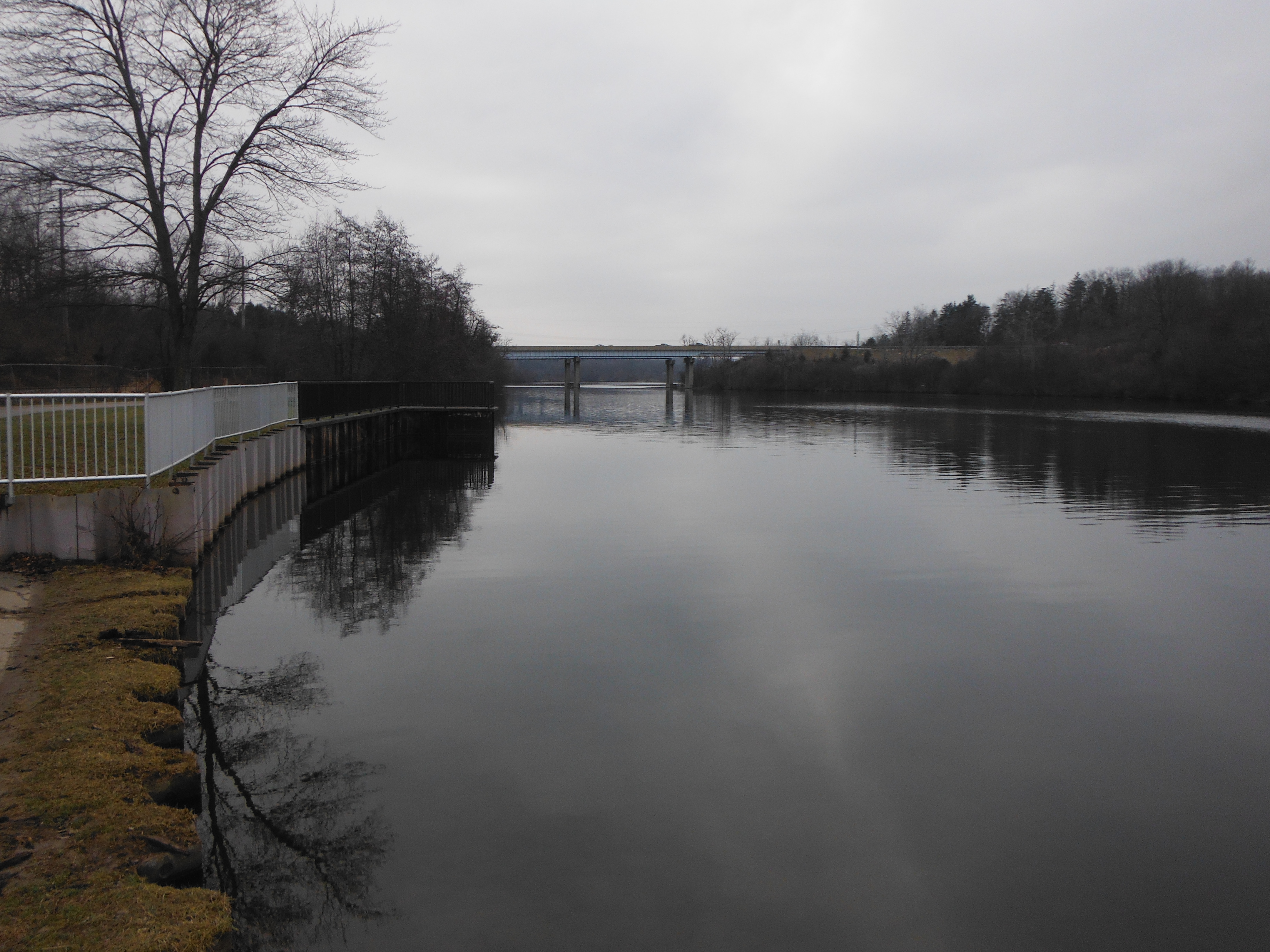
First up, we’ll look at the Huron River at one end of Gallup Park on the Border to Border Trail. The point and shoot picture was taken on the last day of 2021 when I was taking advantage of 40 degree (F) weather to go for a bike ride. The DSLR photo was taken on the first day of February when it also hit 40 F but we’d had enough cold weather to partially freeze the Huron and there was some snow on the ground. So obviously the conditions were different, but the framing is very similar (the 35mm/full frame field of view equivalents1 are 28 mm and 28.8 mm for the XP55 and T6 respectively, so essentially the same). In terms of the other settings, the XP55 used a larger aperture, but with such a short focal length more or less everything is in the range of acceptable focus. With the T6 at f/8 and focusing on the bridge in the background, the depth of field extends to all the way from infinity up to a couple meters in front of me. Both shutter speeds should have been fast enough to avoid camera shake, and the ISOs were the same.

Fujifilm FinePix XP55, 5 mm, f/3.9, 1/150 s, ISO-100

Canon Rebel T6, 18 mm, f/8, 1/100 s, ISO-100

Overall, I think the T6 photo is sharper, and it retained better texture in the sky, which could have been because of the different weather conditions, but I would expect the T6 to have a better dynamic range (the maximum different between light and dark areas that a camera can capture in a single exposure – for the T6 it’s 10 stops; the human eye sees about 21 stops) than the XP55. If we zoom in all the way, the front tree is decidedly sharper on the T6, and if we look at the railing section, the T6 photo is both sharper and less noisy.

XP55 (left) vs. T6 (right)

Next I have a couple photos from separate trips to the library. Again, the T6 photo is overall sharper, which can be seen if I zoom in all the way and try to read some of the book titles. It’s not hugely obvious in the crops below, which proves my point about web resolution. The other part of the photo where the T6 looks sharper than my phone is actually the overhead light fixture. Again, not super obvious below, more obvious on my computer at 100%. The one point that the phone comes out ahead on is its significantly larger aperture that lets in something like 8 times (3 full stops) as much light as the maximum aperture on my DSLR’s wide angle lens, allowing for a much lower ISO. It’s not as noticeable around the books, but I can kind of tell zoomed in to some of the areas that are more monotone in color that the DSLR photo is noisier.

Samsung Galaxy Orbit J3, 3 mm, f/1.9, 1/40 s, ISO-125

Canon Rebel T6, 18 mm, f/5.6, 1/60 s, ISO-1600

Phone (left) vs. T6 (right)

To conclude, yes, a sensor with a 10-30x greater area outperforms a ten year old point and shoot and a Tracfone. However, unless the photo is obviously not in focus (quite possible with my phone photography), you may not be able to tell online, and probably not with small prints either. Where people would be able to tell in practical applications (i.e. not zoomed in at 100% on a computer looking at individual twigs on a tree) is with cropping and larger prints. Lugging around a DSLR is worth it for me for the improved low light performance, ability to change camera settings, and intentionality of framing a photo, but if you only ever look at photos on your phone and rarely print anything, you can probably save your back and your wallet with a halfway decent phone.

1Crop factor can get confusing, but the relevant information here is that it’s based on sensor size compared to the “standard” 35 mm or full frame format. The T6 has a crop factor of 1.6 and the XP55’s 1/2.3” sensor has a crop factor of 5.6 so that focal lengths of 18 mm and 5 mm respectively give the same field of view as a 28 mm lens on a full-frame camera.

Saturday, April 30, 2022

Sense and Sensor-bility

While I was looking things up for my post about how I ended up with the Canon Rebel T6 and my lens trifecta, I also got sucked into finding out about camera specifications, which led to camera sensors. Turns out it was a bit of a rabbit hole.

To start, digital camera sensors are the equivalent of film in analog cameras. They capture light and record color to reproduce images. Older digital cameras often used CCD (charge coupled device) sensors, but they’ve since been replaced by CMOS (complementary metal oxide semiconductor) sensors. Both types of sensors rely on photosensitive semiconductors that convert light into electric charge. The charge is then converted into voltage, and the correlation between light (brightness) and voltage can be used to recreate the photograph. CCD sensors are analog devices that send the charges from each semiconductor through an output node to be transformed into voltage while CMOS sensors convert charge to voltage at each individual pixel. While CCD sensors were originally the sensor of choice because of their low noise, CMOS sensors are cheaper and require less power, and technological advances have improved image quality to equal or better CCD sensors.

For color photography, a color filter array sits on top of the sensor. Commonly used in digital cameras today is the Bayer filter, which contains RBG color filters arranged in a checkerboard-like pattern on the pixel array of a sensor. The Bayer filter has 50% green filters, 25% red filters, and 25% blue filters, which reflects the physiology of the human eye. Because each pixel now only sees either red, blue, or green, the image needs to be processed with a demosaicing algorithm to give each pixel RBG values. For example, a green pixel has its green value measured directly, then can get its red and blue values by interpolating from its red and blue neighbors.

At the library
[Samsung Galaxy J3 Orbit, 3 mm, f/1.9, 1/40 s, ISO-125]

Finally, on to sensor size. In filmmaking and film photography, 35 mm film was the most commonly used film size, so when digital cameras became a thing, a sensor size that matched 35 mm film – 36mm x 24mm – became known as “full frame.” In general, bigger sensors/film require bigger lenses/cameras that are more expensive, so camera manufacturers also came out with so-called “crop sensor” or “APS-C” cameras with sensors typically sized at 22.3mm x 14.9mm (Canon) or 23.5mm x 15.6mm (every other brand). Then there’s the Micro Four Thirds System, 1-inch sensors, and once you get smaller than that (as in a lot of point and shoot/phone cameras), sensor size is usually expressed as something like 1/2.3”. This number ostensibly refers to the diagonal of the sensor, but it’s based on old video camera tubes, which were sized based on outer diameter, not usable inside area, so a 1/2.3” (0.435”) sensor actually has a diagonal of around 0.3” and dimensions of 0.24” x 0.18” (6.17mm x 4.55mm).

Argo Park on the Border to Border
[Fujifilm FinePix XP55, 7 mm, f/4.3, 1/58 s, ISO-100] 

Once you have your sensor, you then divide it into thousands of areas that each correspond to a pixel. The bigger a pixel is, the more light it individually captures, and the better it can capture whatever you’re photographing. For example, the Fujifilm FinePix XP55 has a 1/2.3” sensor and a resolution of 4320 x 3240 so has a pixel size of about 1.4 microns on a side (6.17 mm/4320 = 1.4 microns). My Rebel has the Canon APS-C sensor and a resolution of 5184 x 3456, giving a pixel size of ~4.3 microns. So even though the megapixels aren’t that different (4320 x 3240 = 14 million pixels, or 14 megapixels vs. 5184 x 3456 = 18 MP), the larger sensor and pixel sizes mean improved picture quality.

Tree at sunset
[Canon Rebel T6, 55 mm, f/8, 1/160 s, ISO-100]

Out of interest, I tabulated the specifications for a number of cameras I’ve owned below. The top of the table (click to enlarge) is digital cameras and the bottom is phone cameras. For fun I included Canon’s current most expensive professional mirrorless camera, the R5, which at $3899 for the body alone I don’t anticipate owning any time soon, if ever (I’ll be holding out for a mirrorless crop sensor R-mount camera for when I need to replace my T6; the current APS-C mirrorless line uses a different lens mount with few native lenses and like Canon’s entire range of DSLRs and lenses, seems to be a developmental dead end.). I also put in Apple’s latest and greatest offering, the iPhone 13 Pro, for comparison with my phone, which cost about the same as a pair of Airpods.

I was surprised by a few things, and unsurprised by others. First, I didn’t realize that my DSLR didn’t have many more megapixels than the FinePix XP55 or even the PowerShot SD1300. The sensor size, however, is over 11 times larger in area, and jumping up to a full frame sensor, though it doesn’t look massively larger, still more than doubles sensor area. On the flipside of things, I think I’m justified in my dislike for my phone camera, which at best has a sensor less than half the size of a 16-year-old digital camera. And even though one of the most advanced iPhones has surpassed my more recent point and shoots in sensor size, that sensor is still less than a sixth of the size of my entry level DSLR’s, which is one reason why people still pay hundreds and thousands of dollars for DSLRs and mirrorless cameras.


1My phone camera (unsurprisingly?) not only has microscopic sensors, but also non-standard size sensors, so the inch equivalent is approximated from the sensor dimensions.

2I couldn’t find the aspect ratio for the iPhone’s sensor, but it’s stated to be a 1/1.65” sensor, so those are the approximate sensor dimensions and resolution based on a 4:3 aspect ratio and the given megapixels. Calculations are for the iPhone’s best (largest sensor/most megapixels) camera.

Saturday, March 19, 2022

Near, Far, Wherever You Are

I originally started the previous post to talk about my new camera lenses, but spent too much time going on about how I ended up with the Canon Rebel T6 over one of the dozens of other cameras out there so I split the post up to talk about the body and lenses separately. So here’s the post I meant to write to show off some photos from my telephoto lens (since my ultra wide-angle lens was already featured in my Acadia and Upper Peninsula posts).

When I got the T6, it came bundled with a kit lens – the EF-S 18-55mm f/3.5-5.6 IS II.1 If you mostly want a DSLR for snapshots of everyday life and travel, the kit lens is great. If you’re using an entry level DSLR to dip your toe into photography, it’s still good, especially for a kit lens, but you’ll eventually want a lens upgrade. I ended up shooting with the 18-55mm only for three and a half years, but then bought not one, but two lenses within six months of each other.

One of the things that you actually often lose out on when you first get a DSLR is zoom. While point and shoot cameras and phones can use digital zoom and other tricks to increase focal length, there are physical limitations to whatever lens you have on a DSLR. I like the T6 kit lens, and it’s chosen as the kit lens because it covers a useful range of focal lengths similar to what the human eye sees, but it’s not the sharpest, and I wanted to take pictures of squirrels and other things and have them appear larger than my thumbnail on my computer screen.

Mallard duck [250 mm, f/8, 1/160 s, ISO-1600]

However, I first picked up an ultra wide-angle lens over a telephoto lens because I was about to head to Acadia with my family and I figured I’d rather get better image quality for landscapes on that trip. Based on quality and price, Canon’s EF-S 10-18mm f/4.5-5.6 IS STM3 lens is more or less the lens of choice for landscape photographers (with my lens mount) looking for a new lens after the kit lens. Honestly, I don’t use the 10 mm end that often because the perspective distortion is pretty severe, but it’s sometimes useful for shooting indoors. I do like the lens, and similarly to the 18-55mm, the minimum focusing distance is only a few inches in front of the lens so you can get really close to your subjects.

Tree [121 mm, f/5.6, 1/250 s, ISO-100]

As the fall went on, both Canon and Nikon essentially announced that they were shifting all new development to their mirrorless cameras, and Canon at least has been discontinuing many of their DSLR lenses. I still wanted a telephoto zoom lens, so when I saw a used EF-S 55-250mm f/4.5-5.6 IS STM for a reasonable price with an extra 10% off for Black Friday, I bought it.4 This lens is basically the telephoto equivalent of the 10-18mm, and I’ve enjoyed it so far, though I haven’t taken it on any big trips yet. The main drawback of this lens is its minimum focusing distance of close to 3 feet. After almost four years of being able to crawl right up to my subject, I’m not used to having to stand back a little. It’s fine for picking out details in landscapes, but I keep forgetting when I’m using it to magnify flowers and other nearby objects.

Moon (cropped) [250 mm, f/5.6, 1/320 s, ISO-400]

The 55-250mm lens is by no means a heavy5 lens, but I will say that switching from it to either of my other lenses makes the camera feel extra light. With my three lenses, I now have continuous focal lengths from 10-250 mm (10-18, 18-55, 55-250), with perhaps a slight dip in quality from 18-55 mm. I like the ultra wide/telephoto combination for landscape/nature photography to get overview and detail shots, but the 18-55 mm focal lengths are super useful for general purpose walking-down-the-street photography and indoors (e.g. museums, conservatories). I’m debating whether it’s worth picking up the STM version of the 18-55mm lens for the boost in image quality because I’ve seen it for less than a hundred dollars used, and I’d probably like to try out a “fast” (large aperture) prime lens (likely the EF 50mm f/1.8 STM, or maybe the EF-S 24mm f/2.8 STM) at some point to see what that’s about, but for now I’m happy with what I’ve got.

1I’ve broken this down in another post, but the lens is made for a Canon crop sensor2 camera (EF-S), its zoom range is 18-55 mm, the maximum aperture varies from f/3.5 to f/5.6 depending on the focal length, the lens has image stabilization (IS), and it’s the second version (II) of the lens.

2Camera sensors are a whole other rabbit hole that I’ve fallen down, and I might put together a different post on them.

3STM stands for the Stepper Motor used to autofocus the lens, and it’s a faster and quieter upgrade over the DC motor used in the kit lens that I have.

4Both the 10-18mm and 55-250mm lenses were $300 MSRP. I got the 10-18mm new for that price (+tax) and the 55-250mm used for around $170 total. The 55-250mm is officially discontinued, and the 10-18mm might not be, but it’s probably on the way out.

5For comparison, a super telephoto that someone might be reasonably walking around with (so not Canon’s EF 1200mm f/5.6 L USM lens that’s almost 3 feet long, weighs more than 36 pounds, and costs over $100,000) might weigh around 10 pounds.

Monday, March 14, 2022

The Camera

In February of 2018, I switched from a point and shoot camera (the Fujifilm FinePix XP55) to a DSLR (the Canon Rebel T6). By that time, most people were using phones as their primary photographic device, but I was not for a couple reasons – 1) since my first cell phone in college, I’ve had non-flagship TracFone phones with terrible cameras [my current phone is the first one I’ve owned that even has a front camera (that I essentially never use)], and 2) I’m legitimately quite awful at phone photography, to the point where there’s about a 50% chance any given photo isn’t even in focus. From a technological perspective, the XP55 actually has specifications that are comparable to an average phone camera from around 2018, but the point and shoot market has since been more or less obliterated by phones.

Icy grass [117 mm, f/8, 1/160 s, ISO-400]

Since I’m apparently not capable of getting good phone photos, I was still using a dedicated camera in 2018. After getting increasingly dissatisfied with the XP55, I upgraded to a DSLR. At the time, I knew that Canon and Nikon were two of the major names in the DSLR market and that the Canon Rebel series was frequently recommended for good entry level cameras. When I started shopping around online, the Canon Rebel T5 had been superseded by the T6 for close to two years and was getting harder to find. The T7 was, it turns out, weeks from being announced, and I didn’t know that I’d want any of the features (e.g. more megapixels and autofocus points) that made the T6i more expensive, so I ended up with the relatively affordable T6.

Squirrel [157 mm, f/5.6, 1/160 s, ISO-800]

Broadly speaking, a larger camera sensor tends to improve the overall “image quality,” increasing sharpness, how much you can crop or enlarge a photo, and low light performance. Going from the XP55 to the T6 increased my available sensor area by over an order of magnitude, so that was an immediate upgrade, even if I had stuck the T6 in auto mode and left it there. I was, however, also interested in learning about having control over aperture, shutter speed, and other settings, so I spent some time with photography books and dragging my camera a lot of places with me.

Trumpeter swans + ducks [121 mm, f/9, 1/160 s, ISO-400]

I’ve now had my T6 for just over four years, and taken close to 12,000 photos with it. My camera’s ridden with me on Amtrak to Chicago (twice), flown to Houston for the Society of Rheology annual meeting, gone to see family in Singapore, been dragged to Orlando for AIChE, visited Acadia, taken a trip to Michigan’s Upper Peninsula, and gotten biked all across and around Ann Arbor. As of late, most of the big players in the field are focusing their development on mirrorless cameras, but I’m still a fan of this entry level DSLR. I paid $330 for it new with the kit lens, so it’s not so expensive that you have to worry about every bump and scrape, but it’s still a nicely built piece of equipment that has plenty of capability, though not all the bells and whistles of a flagship camera.

The T6 doesn’t have in-body image stabilization, though all the lenses I have do. The general rule of thumb is to keep shutter speed faster than the inverse of the focal length, which I find works fine to get acceptably sharp photos, especially with my lenses rated for 3-4 stops1 of image stabilization. The T6 also isn’t weather sealed, so I wouldn’t put it in a puddle or go out in a downpour, but it’s been fine in light to moderate rain and snow as well as cold. It further lacks a touchscreen, a tilt-out screen, and a live histogram (though does have live view, which I use on occasion), but I’ve never had any of those features so I’m fine without them.

The T6 has a bunch of photo modes, but I used auto for about one night to try out the camera, then it’s been in manual since then, and I’ve never taken video with it. I also don’t use burst mode, which is important for sports/action shots. I prefer shooting in full manual mode, but I use it very similarly to aperture priority a lot of the time, and I’m currently in a months-long trial of back button focusing2, which I think I like. Although above around ISO-800, the noise starts being not great in certain situations, it’s a huge improvement over my point and shoot, so I’m not complaining too much. Overall, I’m very happy with the T6. It’s not the most brilliant camera out there3, and sure, I’d like to have the latest and greatest equipment, but the T6 is a more than capable camera for my adventures, and I’ve enjoyed my time with it so far.

[This post features photos from my newest telephoto lens. I also have a new-ish ultra wide-angle lens, which a lot of the photos from my Acadia and Upper Peninsula trips were taken with.]

1Camera stops are a measurement of how much light the camera is seeing. One stop is half or twice as much light as the stop lower or higher than it. You get more stops of light by opening up the aperture, lengthening shutter speed, or increasing ISO. Image stabilization helps to eliminate blur caused by motion of the camera, which allows the shutter speed to be increased.

2Instead of half pressing the shutter to (auto) focus, you focus using a separate button on the back of the camera (hence back button focus). This decouples the actions of focusing and taking the picture, which allows you to set the focus where you want it, compose your photo, then take the shot instead of constantly having to refocus, assuming the focus point isn’t changing.

3It’s maybe just a little short on megapixels compared to newer cameras, and the lenses often aren’t the sharpest in the world, but since most people apparently only look at photos while scrolling through Instagram on their phone, no big deal, right?
Wednesday, June 10, 2020

All the Small Things

I’m back from crawling around in the underbrush and possibly getting poison ivy, Lyme disease, and/or malaria to bring you another round of pictures of plants. You may have noticed recently that besides my end-of-month coronacation reports, I’m not posting about activities that happen on any particular day. The reason is twofold. 1) I’m not taking any trips/travelling, and basically all events have been cancelled – band/orchestra concerts, in-person library programming, seminar speakers, even the Arboretum people asked people not to go see the peonies in person this year. And 2) There are only so many ways you can say you went wandering in the woods, startled a lot of squirrels and chipmunks, and waded through weeds and mud (plus new for June – got eaten alive by bugs). Not every walk warrants its own post, so be glad you’re just getting the highlights.

I will say that a good thing to come out of the coronavirus quarantine is that I’ve finally explored parts of Ann Arbor well within walking distance of where I’ve been living for the past four years. Also it turns out work gets done when you sit down and work instead of distracting your coworkers. But back to the plants. I practiced my plant identification skills to give you my best guesses as to what the wildflowers I’ve encountered are. I actually managed to find the ones I had little to no idea about by scrolling through this page, which is pleasantly very 2000s in terms of web design.

First up, trillium, likely Trillium grandiflorum, or great white trillium or large-flowered trillium. I spent my very last BRBs (Big Red Bucks) at Cornell at Trillium, a cash/BRB dining option by the ag quad. After our blisteringly warm and humid convocation, my family and I went for a special graduation-weekend lunch at Trillium before hiking at Watkins Glen.

Trillium grandiflorum (Great White Trillium)

Next we have another dandelion picture, because I’m pretty happy with the focus on this one.

Our friend Taraxacum officinale (Common Dandelion)

That’s followed by one that took a lot of scrolling, but I’m pretty sure it’s dame’s rocket (Hesperis matronalis). It’s described as prolific and as having plentiful flowers, which definitely fits what I’ve seen of it. It was everywhere along some of the trails I walked this spring. Its name comes from the ancient Greek for evening, possibly because its scent becomes more prominent in the evening.

Hesperis matronalis (Dame's Rocket)

While I was looking for the dame’s rocket, I found wild geranium (Geranium maculatum). This is another flower that I’ve seen in quite a few places around Ann Arbor but never bothered to identify until now. Confusingly enough, geraniums that you might buy to plant in your garden are in a separate genus – Pelargonium. They were originally classified in the same genus by Linneaus, but split up in 1789.

Geranium maculatum (Wild Geranium)

And finally we have a flower that I had narrowed down to some sort of daisy, probably Erigeron annus, or eastern daisy fleabane. That’s it for this time. Back next time with different types of grasses.1

Erigeron annus (Eastern Daisy Fleabane)

1Probably not really.

Friday, May 8, 2020

Close Encounters of the Plant Kind

Or: Things You Never Knew You Wanted to Know About Every Cell Phone and Camera I’ve Ever Owned 

Currently, my only outdoor activity is semi-aimless wandering around outside while trying to avoid other people as much as possible. Which really isn’t too far from my normal outdoor activities, but lately in doing so, I’ve discovered a number of parks and nature areas accessible to me. The nature areas are basically just woods with unpaved paths that people have ended up making through them. Many of them have no signage or parking lots and are accessed through neighborhoods. They tend to be pretty quiet and unfrequented, especially if you visit during weird times and questionable weather conditions, and the trails can get unmaintained and muddy, all of which suits me just fine.

Moss friends. Non-vascular plants that produce spores, not seeds.
So you could say they reproduce spore-adically.
55 mm, f/5.6, 1/160 s, ISO-100

I usually take my camera along with me, because what I really need is to add to my collection of pictures of trees, and also you never know when you might stumble on something worth photographing. Since I really do have a lot of photos of trees, I’ve recently been trying to take pictures of other plants when I go out. This also takes advantage of a DSLR’s ability to play with depth of field and exposure. Point and shoots tend to have a large depth of field because of their short focal lengths and smaller sensors, so a lot of the picture will be in focus. I would say this is true of phones as well, but of course some of the newer iPhones are starting to be able to control depth of field, though I think it’s done on the iPhone via post-processing, not as the photo’s being taken.

Probably some sort of bluebell.  Possibly Virginia bluebells.
55 mm, f/5.6, 1/160 s, ISO-200

On my trusty Fujifilm FinePix XP551, which I’m not sure is retailed anymore, even if anyone actually wanted to buy one, the most control over the settings you have is picking the ISO and white balance, which amounts to choosing how blurry and discolored you’d like your photo to be. There’s also a macro option, but at best it kind of works. My current phone has a camera that’s merely not great as opposed to absolutely abysmal, but I’m apparently old and grumpy enough that holding my phone still, keeping my finger off the lens, and getting the touchscreen to register that I am, in fact, pressing the shutter button all at the same time is more trouble than carrying an entirely separate device.

Taraxacum officinale.  Otherwise known as the common dandelion.
55 mm, f/5.6, 1/400 s, ISO-100

I got my first cell phone when I went to college. It was a flip phone that I had for about a year and a half. I’m pretty sure it had a camera, but I don’t remember ever actually using it. That phone was replaced by a touchscreen phone. I didn’t ask for it; it was paid for and mailed directly to my dorm room by my parents. This was the phone that I dropped sometime during winter of my junior year trying to get into Olin on a weekend. I put tape over the parts most likely to splinter into my finger and kept using it. I did end up getting a new phone after that school year, which I used for almost four years, well into grad school. That phone was notable because in the age of selfies and facetiming, it had no front camera. The camera it did have was functional, but you wouldn’t choose to use it unless your other option was something like, say, carving stone tablets. I also just discovered that I did at some point crack the screen all along one side. I eventually replaced that phone because apps stopped updating for that version of Android. Now my phone has both a front and back camera, and I do occasionally take pictures with it if I need a quick snapshot of something or don’t have my DSLR. I still do all my primary photography with a dedicated camera (the Canon Rebel T6) though, and still only have the kit lens. Anyway, enjoy the plants.

Bonus: Not a plant.  Polypores, or bracket or shelf fungi.
55 mm, f/5.6, 1/60 s, ISO-100

1This thing is waterproof, shockproof, dustproof, and freezeproof2. It survived being dragged almost everywhere I went at Cornell. Four years of hockey rinks, pep band trips, hiking gorges, mealtimes; it’s been exposed to zero-degree weather and taken to the top of the climbing wall. I still keep it charged but only use it in situations where I can’t bring my DSLR.

2Why yes, I have damaged at least 2 phones and 1 camera (some model of a Canon PowerShot, if I remember correctly) by dropping them.

Monday, August 19, 2019

Peonies are Pink

Late May in Ann Arbor means two things: 1) The grad students are settling into summer and 2) It’s peony watch time at the Arboretum. After a hectic semester in the lab, we welcomed the chance to sit down and get some research done without the distractions of seminars, office hours, grading, homework, classes, and 5 million emails every day. While we (finally) got some work done, the greyness of winter and spring slowly crept away, the temperatures inched upward, and plant life started to return to Ann Arbor. This year, thanks to an abnormally cool and rainy spring, the peonies were over a week late, but after multiple trips to the Arboretum, I eventually caught them in full bloom.

After all, what’s the point of having a fancy camera if you don’t go take fancy pictures with it? As an added bonus, this year it was cloudy and overcast on the day I visited during peak bloom, giving me great diffuse lighting. The first summer I spent in Ann Arbor, I accidentally showed up at the Arboretum after work one day when the peonies were in bloom. Because it was evening, the light was decent, but at that time I only had my point and shoot camera. Last year, I took my mother to see the peonies while she was visiting. We went in the middle of the afternoon, and it had been cloudy, but cleared soon after we arrived so that the garden was in full sunlight. Bad for the un-suncreened and photographers alike. I had my DSLR and got some okay pictures, but there were also a lot of blown out highlights and details hidden in shadows.

When I finally got my peony pictures this year, I came away with some shots that I’m pretty happy with. The lighting was good and I even got a few cool pictures where the background is blacked out but the peonies aren’t. Normally, to get this effect on purpose, you can use flashes to light your subject and use a fast shutter speed to only pick up light from the flash and not ambient light (explained here, used at a convention here). In this case, I semi-accidentally had this happen because the light-colored peonies in particular were still picking up a lot of indirect sunlight while the stalks behind them were not. This meant that the difference in exposure was significant (3 or 4 stops? More?) and exposing for the flowers left the background extremely underexposed and black. That’s your photography lesson for the day; the peonies are below:


Monday, July 23, 2018

April Showers

After the freezing rain came the normal temperature rain, and after that came the flowers. Because April showers bring May thunderstorms flowers. Following the purchase of my camera, I read a couple of photography books, but the best way for me to get better at taking photos was to start taking an excessive number a lot of photos. Therefore, my camera started coming along with me on my Saturday errands, which neither snow nor rain nor heat nor gloom of night stopped me from.

Top left: Tulips in my backyard (leftovers from some previous tenant)
Bottom left: Purple flowers (possibly some sort of violet?) on central campus
Right: Pink flowering tree (vaguely cherry blossom-esque) by the library

Top: Butterfly weed at the arboretum
Bottom let: Dandelions.  Everywhere.
Bottom right: Some pink flower that was labelled at the arboretum but
of course I wasn't paying attention to what the sign said

In case you couldn’t tell, I know a lot almost nothing about floriculture. The only flower I’m pretty sure I managed to identify was the butterfly weed, because there are approximately two species of bright orange wildflowers. The tulips and dandelions don’t count because those are basically common knowledge. Thanks to a seventh-grade science project, I can, however, identify a couple dozen species of trees that grow in New England. We had to collect leaves and seeds from at least twenty-five deciduous and coniferous trees and look up other information about them (the scientific name for the red maple is Acer rubrum, in case you were wondering; don’t ask why that’s still in my memory). Turns out that was one of the projects that (somewhat) has real life applications, like tracking the phases of the moon and writing checks in elementary school. Unlike, say, fugacity.

Monday, July 9, 2018

Ice Ice Baby

We’re going back to February April for this post. Three weeks into astronomical spring, as defined by the vernal equinox, and a month after the end of Punxsutawney Phil’s predicted six more weeks of winter, Ann Arbor was hit by an ice storm. You know, that clear, hard, slippery stuff that’s the solid state of water. Density of approximately 0.9167 grams per cubic centimeter. Only exists below 32°F at atmospheric pressure. That stuff. A month into spring, when people are supposed to be wearing shorts and raincoats, I found myself in gloves and snow boots, but at least I got some good pictures out of it.

Ice on branches

Ice on grass

Ice on soccer net

A couple weeks after the ice melted, spring kind of arrived. The weather ping ponged between mildly warm and sunny vs. cool and rainy for the rest of the month, then moved into hot/sunny/thunderstorms for most of May. We got 2.6 inches of precipitation in April and 6.74 inches in May, according to U.S. climate data (2.89 and 4.91 inches from Weather Underground). Average is 3.23 and 3.43 inches, also from U.S. climate data. It was cooler than normal in April, warmer than normal in May, and we hit 90°F multiple times before June was over. My un-airconditioned apartment reached a maximum of 87°F. If it hits 88, I think a time travel portal opens in the basement or something.

On a non-weather-related note, April brought the end of classes and TA’ing for me, then I took my preliminary exam (written report + oral presentation about my research and thesis plan) in May. Immediately after passing the prelim, I took off for Chicago for a week to see my brother and all the other things I didn’t get to see there last year when I moved his things into his apartment for him. Posts and pictures to come, because yes, I took way too many pictures. My excuse is that:

1) I’m a grad student. I needed a new hobby to go along with solving the daily crosswords and jigsaw puzzles. I am aware that I have the taste of a retired seventy-year old grandmother. Should I take up knitting, cross stitch, bridge, or bingo next?

And 2) I’m already that person that nobody notices at events. I might as well be that person nobody notices with a camera. [Funny/not so funny fact: People lose track of me because I’m below their sight lines. One moment I’m on their right, the next I’m climbing through their bedroom window at 3 am on their left. I also apparently walk without making enough noise, and semi-frequently startle people.]

I think that’s enough random rambling for now. #PeaceOut That’s how the cool kids do it nowadays, right?

Sunday, June 24, 2018

Say Cheese

I don’t think it’s too much of a stretch to say that considering a purchase on and off for more than three years classifies it as a non-impulse buy. Earlier this year, I finally got fed up enough with my point and shoot camera to buy a DSLR. To be fair to my old camera, it is drop-proof, windproof, waterproof, and dustproof. However, it does not do well with indoor shots, low light, or focusing, so I gave in and bought a DSLR. Since the whole point of a DSLR is to be able to choose your own camera settings to take better pictures, I’ve been shooting in manual for the past few months. Am I doing it right?

I do actually know how to read the light meter, I promise.
The three main settings you control in manual mode are the aperture, shutter speed, and ISO. The aperture is the hole in the lens that allows you to vary how much light reaches the camera sensor. Aperture is measured in f-stops, written as f2.8 or f22 (sometimes f/2.8 and f/22). Confusingly enough, a small f-stop number means a large opening, which results in more light hitting the sensor. Conversely, a large aperture value means a narrow opening and less light. Depth of field is also controlled by the aperture; shallow depth of field is achieved with a small f-stop value and greater depth of field with a high f-stop.

Left: aperture = f/5.6
Right: aperture = f/36
Background on the left is blurred out while the right is kind of/mostly visible.
[Click pictures to enlarge.]

The shutter speed is how long the shutter is open. Shutter speed is measured in fractions of a second, and intuitively enough, longer shutter speeds mean more light while shorter shutter speeds mean less light. In situations with moving objects, the shutter speed becomes important, and determines how much or little blurriness there is in a photo.

Top: shutter speed = 1/640
Bottom: shutter speed = 1/15
The fountain and water in the bottom picture should look smoother than the top.

Lastly, ISO refers to the light sensitivity of the sensor. Back in ye olde days before digital cameras, you would have to buy film with different ISO values and when you needed to change ISO – if, for example, you moved from a brightly sunlit field to a dungeon – you would have to physically switch your film. I know, how slow, inefficient, and utterly barbaric. A higher ISO value means that the film/sensor is more sensitive to light, so you would tend to need a high ISO for dark or indoor scenes. A low ISO means that the film/sensor is less sensitive to light. So why wouldn’t you always want a high ISO if it’s more sensitive? The higher you go with the ISO, the grainier the picture because the film picks up more noise.

I don't have a set of pictures directly contrasting ISO, but the above picture was taken with an ISO of 1600 and shows the graininess you get at high ISO.  (For comparison, all other pictures here had an ISO of 100.)

The aperture, shutter speed, and ISO can all be varied to compensate for each other so that the correct amount of light reaches the sensor for a properly exposed photo. For example, if you’re shooting trees outdoors in sunlight, you would usually be using a low ISO, high f-stop, and moderate shutter speed. If you then decide to start taking photos of a fast-moving flying potato, you would decrease your shutter speed. To balance the loss of light reaching the sensor, you could either decrease your f-stop value, increase the ISO, or a combination of both.

That’s the ten minute guide to shooting in manual with a DSLR. Most of my pictures from here on out will be with my new camera (yes, I actually did things and have things to write about that aren’t the Revolution). I ended up buying the Canon Rebel t6 with just the kit lens [ES-S 18-55 mm f/3.5-5.6 IS – the ES-S means that the lens is compatible with the APS-C sensor, which is not a full frame sensor; 18-55 mm is the range of focal lengths (zoom); f/3.5-5.6 is the range of minimum f-stop values, which vary depending on the focal length; and IS stands for image stabilization, which helps to prevent blur at low shutter speeds]. So far I have not bought any other lenses, filters, or accessories, with the exception of a camera bag. I plan to keep it that way for awhile, but we’ll see how long that lasts.