Showing posts with label Singapore. Show all posts

Saturday, May 4, 2019

Food, Glorious Food, and Denouement [Singapore 2018]

Besides family and tourism, the other aspect of a trip to Singapore is the food. We ate out a lot, because the cost of prepared food isn’t that high compared to the cost of groceries, and there are numerous dishes that you can’t get in America. Or at least you can’t get good versions of them in America. While Ann Arbor has a bar for every day of the month (at least), it’s surprisingly lacking in Chinese food. There’s one place off North Campus that’s good, then a couple American-Chinese restaurants around town, and a Panda Express at the commons. So this was my opportunity to get some decent Chinese food, plus a mix of Singaporean/Malaysian/Indian food, plus the kind of weird stuff.

We had satay a couple times. I like the meat, but as you may have guessed based on the three hundred peanut butter and jam sandwiches I eat every year, I’m really in it for the peanut sauce. One night we met up with some of my father’s friends for dinner at a Peranakan place and got chicken curry. Another night we had dinner with a couple of my aunt’s and one of my mother’s cousins and had dim sum and duck. There was a lunch with family friends where we just got dim sum. We had variations on noodles, bao, chicken rice, porridge, kaya toast, egg tarts, pineapple tarts, Pop-Tarts – wait, not that last one. There was a lot of food.

Clockwise from top left: Duck, dimsum, satay, curry

And then there were green worms, tentacles, and the obligatory I-went-to-a-tropical-place coconut. The green worms are pandan-flavored noodles, and are part of cendol, shaved ice topped with coconut milk and palm sugar syrup served with the noodles. You can also add other ingredients, like red beans, durian, corn (. . . why?). It’s good. Then probably the most unusual thing I ate was the tentacles (cuttlefish). Tasted fine to me. But the first time I ate blue cheese I didn’t realize it was blue cheese until three-quarters through the meal, and I’ve had the assorted-body-parts-and-fungus-soup at Chinese restaurants, which was also fine. The coconut was a coconut.

Clockwise from top left: Cuttlefish, cendol, crab*, and coconut
*Soft shell, dry ice for theatrical effect

Now, to end this series of posts. To summarize, we went to the following:
Day 5: Singapore Botanic Garden (with National Orchid Garden) and Southern Ridges
Day 6: Gardens by the Bay
Day 7: Sentosa – Trick Eye Museum and S.E.A. Aquarium
Day 8: Jurong Bird Park and Night Safari
Day 11: Asian Civilisations Museum
Day 12: Sentosa – Fort Siloso
Day 13: Singapore Zoo and River Safari
Day 15: Bukit Timah Hill
Day 17: Singapore National Museum (same link as the Asian Civilisations Museum)
Day 20: Hong Kong

There’s nothing we saw that I would categorically tell people to avoid, but your enjoyment may vary depending on your idea of fun. For example, if you hate sweating, Singapore is the wrong country for you, but if you find yourself there anyway, you may not want to haul yourself up Bukit Timah Hill. Or if you have a phobia of coral, the aquarium is probably not the right place for you. But if you like flamingos, go to the bird park.

Within a little over two weeks, I managed to see ~85% of my extended family, including 13 out of the 14 great-grandchildren on both sides of the family; eat a slightly ridiculous variety and quantity of food; and visit over a dozen quality tourist attractions. I’m glad I made the trip when I did. It’s been awhile since I had a big vacation, and it was a good time to go. Grad school vacation days are probably more flexible than real job vacation days. Hopefully it’s less than eleven years until I see my relatives again.

With that, we return to regularly scheduled posts about the Revolution (new season, same old losing record1), grad student life (why do I have one-sixth of an onion and two dozen eggs in the fridge?), what I’m reading/watching (we got Netflix), and Ann Arbor in winter. Because if you guessed that snowstorms, negative thirty windchills, single digit temperatures, and black ice were absolutely no deterrent to me going to work, grocery shopping, or trekking through the Arboretum, you’re right.

Singapore skyline at sunset

1Except, unbelievably(?), worse than usual.

Tuesday, April 30, 2019

Hong Kong [Singapore 2018]

After the excitement and activity of the past two weeks, we had one last whirlwind day before settling in for the flight back to New England. We left Singapore after midnight, landing in Hong Kong at the bright and early time of 5 am with a thirteen-hour layover ahead of us. This long stop was intentional, because if you’re in Hong Kong for less than twenty-four hours, you don’t need a visa. Thirteen is less than twenty-four, so yes, we left the airport. We cleared customs, then had a breakfast-snack at the one restaurant that was open at 6 am before setting out on our adventure.

We took a train from the airport to Central (Hong Kong Island) and walked from there to the tram that goes up Victoria Peak. The tram is a funicular (cable railway), which the internet says has a maximum steepness of 48%. For reference, US highways can have a maximum of a 7% grade, and the maximum grade for a railway without cables or rack rail is 13.5% for the Lisbon tram in Portugal. So we took the tram up Victoria Peak. It was steep. On the way up, we got the first overhead views of Hong Kong. From the ground, you get a sense of the busyness of the city, but from above, you can see how built up it is. It’s all skyscrapers packed into a narrow strip of land between water and mountains.

Views from Victoria Peak, descent on the tram

Once we got to the top of Victoria Peak (552 m), we first had to find our way out of the tram station, then we took a walk around the peak along the Hong Kong Trail. It’s fairly flat and paved, so not difficult, but it’s nature-y, and you get views of the surrounding hills, Victoria Harbour, Central, Kowloon (across the harbor), and mist/fog/smog. It wasn’t the clearest day, but not as bad as the time we were at Acadia hiking up Cadillac Mountain, got caught in rain, and saw nothing but fog and clouds1. We still got some nice views and pictures, complete with hair/dust/lint on my camera lens that magically disappeared later. It could have been a sleep deprivation-induced hallucination, but I can still see the hair/dust/lint on my pictures now, so it was probably a hair/dust/lint.

After completing the loop around Victoria Peak, we took the tram back down and returned to the train station to have dim sum for an early lunch. We still had six hours until our flight, so next we left the station again and took the ferry across Victoria Harbour to Kowloon. We spent some time walking around Kowloon, found a park, then took the subway back to Central, where we caught the Airport Express to the airport. There, we went through customs and security, bought some cookies, and found our gate all the way at one arm of the airport. Never travel with me if you’re in a hurry. The bus I’m trying to catch will inevitably go out of service as it passes my stop, my plane connections are at opposite ends of the airport, and if things are going smoothly, the train will pull over to restart the electrical system, but don’t worry, everything’s fine. All mostly true stories.

View of Central from Kowloon, Kowloon Park, sculpture in Kowloon Park, Somewhere over Canada

Again, the flight between Hong Kong and New England was long, but bearable. I got chicken and strawberry ice cream for dinner/breakfast [8:00 pm HKT/7:00 am EST] and yet more questionable eggs for breakfast/dinner [7:30 am HKT/6:30 pm EST]. I rewatched Frozen for Sven and the trolls, and saw both Mamma Mia! and Mamma Mia! Here We Go Again, so yes, I had ABBA stuck in my head for the next two weeks. No regrets. And then, fifteen and a half hours after leaving Hong Kong, after crossing half the globe, we returned to the cold caresses of New England. We were back.

1For the record, I was the only one with a rain jacket, because be prepared. You never know when it might start raining, or the temperature could drop twenty degrees suddenly, or you might have to catch and subdue a bird.

Monday, April 29, 2019

Bukit Timah Hill [Singapore 2018]

In this expedition report, we ascend to Singapore’s highest point, no support team, intermediate camps, or supplemental oxygen required. That’s because Singapore’s highest point, Bukit Timah Hill, is 163.63 meters above ground level. That’s one hundred and sixty; not one thousand, six hundred; or sixteen thousand. So it’s about one and a half soccer fields high. The world record for sprinting 200 meters is 19.19 seconds. At least its steepness spares it from being climbed in less time than it takes to air a Super Bowl ad.

We trekked walked to base camp the visitor’s center from Beauty World to begin our journey. The path is paved, but the initial rise is steep enough that I wouldn’t recommend strollers, wheelchairs, or roller skates. There are some unpaved, less straightforward trails around the nature reserve, but we didn’t take any of them this time. After the main trail levels out, it’s a quick and easy walk to the summit flag summit rock at the top of Bukit Timah Hill. Following the mandatory pictures commemorating our conquest, we clipped back into the fixed ropes walked back down the hill.

Summit rock

Taking our time and with a slight detour, it took us an hour to get up and down Bukit Timah Hill. It wasn’t crowded, but there were a decent number of people also walking around; we probably saw two or three dozen people in total. (You haven’t seen crowded if you haven’t hiked something like the gorge trails at Taughannock or Watkin’s Glen on a weekend in summer. Bumper to bumper traffic the whole way through, and you’d better hope you don’t get stuck behind the extended family with a double stroller who walks at their three-year-old’s pace straight down the middle of the trail or the guy who’s taking advantage of the sights, smells, and sounds of nature by smoking while on a phone call.)

Back at ground level, we next walked to a nearby quarry where we saw the quarry, plus a small horde of monkeys. We still had some time before our dinner engagement, so we walked another couple miles down an old railway turned walking path. It was fabulously wet and muddy. It was sufficiently nature-y, though it paralleled the road so we never got away from the traffic sounds, which is my number one complaint/gripe/disappointment about Ann Arbor. In Ann Arbor, it’s really hard to get somewhere where you can’t hear/see traffic, train horns, the helicopter taking off from the hospital, or buildings if you don’t have a car. I’m pretty sure the four-lane road between North and Central Campus has more traffic than the two-lane highway leading out of Ithaca. The highways encircling the city also make it difficult to access certain portions of Ann Arbor as a pedestrian/biker. I have a whole Ann Arbor rant, but for now, I was halfway around the world surrounded by 5.6 million of my closest friends.

The quarry

Saturday, April 27, 2019

Zoo and River Safari [Singapore 2018]

The reason we went to both the Jurong Bird Park and Night Safari was because they had a deal where you could go to those two parks, plus the zoo and River Safari, for a total of $86. At just over $20 per park, it was a deal we couldn’t pass up. I think we had a week to go to the remaining parks after the bird park and Night Safari, so we picked a day to visit the zoo and River Safari and use up our tickets.

Clockwise from top left: penguins, tiger, zebras, rhino, reptiles

The zoo is a pretty standard zoo. They have a variety of animals including elephants, monkeys, penguins, sea lions, otters, zebras, giraffes, and lions, and tigers, and bats. It’s a decent sized zoo, with enough to see to keep you busy for a least half a day, not so small that you wonder why you paid money to see it, but not so huge that there’s no way you can see everything. Throughout the day, there are also a few shows and animal feedings that you can attend. We saw the sea lion show and the elephant show. The sea lion show was better in terms of what the animal can be trained to do. Sea lions can dive and jump, and walk on their flippers; elephants can . . . open their mouths really wide? Useful in certain circumstances, perhaps, but not as exciting to watch.

Sea lion and elephant shows

After the zoo, we went to the River Safari, which is right next to the zoo. [The zoo, River Safari, and Night Safari are all at the same place, and the bird park will soon be moved to the same location as well.] The River Safari suffers a bit from not quite having its own niche. It’s generally themed around animals that can be found near water, but its main draw is . . . pandas. What I learned from Zoo Tycoon was that besides being very hard to keep happy and reproducing, pandas are highland/mountain animals. So . . . not river creatures. The problem is that any fish at the River Safari can be found at the aquarium, any birds at the bird park, and any other animal at the zoo, leaving the River Safari without a signature animal. Hence the pandas.

Anyway, we saw a variety of fish, birds, monkeys (also not river animals?), manatees, an alligator, and the pandas. The pandas are in their own special exhibit and were being fed when we were there, so we got to see them go through the process of stripping and eating bamboo. And I don’t think I’d gotten to see live pandas before, so that part was worth it. The manatees were also interesting to see. They were in a large tank where they all just kind of slowly float around.

A panda

Overall, the River Safari is the least entertaining/developed of the four animal parks, but if you want to a) see the pandas or b) take advantage of the deal to see all four parks, it’s worth a couple hours to walk through. It’s not a bad park; it’s just not as good as the other three more established parks.

Saturday, April 20, 2019

Sentosa – Fort Siloso [Singapore 2018]

This was the day my breakfast included cheesecake. Nothing like quality nutrition to begin the day. It contained lemon and raspberry, so it covered more than half of the food groups, including fruits, so that makes it healthy. We spent most of the morning at my aunt’s house before going to meet another aunt for lunch and an afternoon back on Sentosa. Once again, we walked to Sentosa, but this time we were there to do some free things. First, after lunch we walked to Fort Siloso, a gun battery that formed part of Singapore’s defenses during WWII.

View from the Skywalk overlooking beaches and ships

In December 1941, as the Japanese were bombing Pearl Harbor, they also began attacking US- and British-held territories in Asia. Allied forces in Malaya and Thailand were disorganized and didn’t expect the Japanese to be able to navigate the jungle, resulting in Allied withdrawal from the region by the end of January 1942. Using bicycles and light tanks, the Japanese then made their way south through Malaya towards Singapore. The causeway connecting Malaya and Singapore had been blown up, but in the second week of February the Japanese began using boats to land on Singapore. A week later, the British commander in charge surrendered. In total, 130,000 people in Malaya and Singapore were captured and Singapore was occupied by Japan until the end of the war, three and a half years later.

Exhibit (in the store) + cannon at Fort Siloso

Today, Fort Siloso can be reached by a Skywalk that affords views of the mainland, Sentosa’s beaches, and the many ships anchored off the island. Assorted artillery is located around the fort, presumably in some approximation of their original configuration. Some of the restored buildings include the fort’s general store, command post, casemates (fortified gun emplacement), and barracks. Some buildings have information about the background of Singapore’s defenses and life after Japanese occupation while others are recreations of what they might have been like during the war. The surrender chamber has a wax reenactment of the Battle of Singapore. It’s all still a bit of a work in progress, but an interesting look at a part of Singapore’s history that people might not think about in the midst of high rises and shopping malls.

From there, we paid a visit to the southernmost point of continental Asia and had the world’s fastest swim at the beach (80-degree water temperatures – never before seen in New England, where the air temperature in summer sometimes doesn’t reach 80). The swim had to be that fast because we were meeting an aunt for dinner on the other side of the island. It was a fancy hotel buffet, where my goal as usual was to see how many different desserts I could try. Four, for the record.

View of Sentosa from the southernmost point of continental Asia

Thursday, April 18, 2019

Asian Civilisations Museum/National Museum [Singapore 2018]

It wouldn’t be a vacation with me without at least one museum. As it turns out, we visited two, on separate days. The first was the Asian Civilisations Museum, featuring art and items from Asian civilizations. Probably the most unique exhibit/collection in this museum is the hundreds of bowls from the Tang Shipwreck. The ship was an Arabian dhow sailing from China on its way back to Iraq/Iran around 830 A.D., but was found in 1998 off the shore of Indonesia. Both the ship and the cargo were well-preserved, protected by sediment. The ship is unusual not only for surviving over a millennium underwater, but also because it was sewn together. The cargo, which included 70,000 Tang dynasty ceramic pieces, survived because many of the bowls were nestled in tight spirals inside larger storage jars, then further cushioned with straw.

Bowls from the Tang Shipwreck

The rest of the museum contains other ceramics from various time periods, some paintings, furniture, musical instruments, and Buddhistic and Taoist statuary. It’s not a huge museum, and not my favorite, but it was a good change from some of our other activities, and there’s a decent variety of items in their exhibits. Worth going if you want something quieter/less touristy than the zoo or Sentosa, or if you’re a pottery aficionado.

Asian Civilisations Museum

Near the end of our trip, we met up with one of my aunts/uncle and a cousin and his family. We had lunch together, then went to the National Museum of Singapore. The main part of the museum on the first floor covers Singapore’s history, from its existence as a trading port, to British colonization, its role in WWII1, the merger with Malaysia, and its subsequent independence. They had various artifacts throughout the exhibit, ranging from a bell cast in Paul Revere’s foundry and war documents to an opium bed and a mid-century kitchen. Even though I was dragged through a decent portion of this exhibit by my niece, I thought it was interesting and educational, especially since I didn’t grow up in Singapore, and the last time I was in the country I was still learning arithmetic and the parts of speech.

On the second floor, other exhibits include the Story of the Forest, Surviving Syonan, and Voices of Singapore. Story of the Forest is kind of cool – you start at the top of the exhibit, then walk down a spiral ramp. As you walk downward, the walls are video screens with moving forest scenes on them that are inspired by/digitized versions of drawings from a museum collection. Surviving Syonan covers Singapore during Japanese occupation in WWII1, and Voices of Singapore is about fine and performing arts in Singapore. They have posters for orchestra concerts and TV shows from the 70s, and a theater where the seats are cars. We saw one other exhibit about fashion, then we ran out of time. Overall, I think I liked the National Museum a little better than the Asian Civilisations Museum. I’m not a huge art person, and the National Museum was generally more informative. Again, though, this museum was much quieter than, say, Universal Studios.

Clockwise from top left: fashion, Story of the Forest, National Museum mini-façade, 70s concert posters

1More on this in a later post.

Sunday, March 31, 2019

Jurong Bird Park and Night Safari [Singapore 2018]

The following day (if you haven’t caught on yet, basically every day after the first couple days when we needed to meet up with people, we were out doing touristy things, often with some assortment of relatives), we had another doubleheader, this time accompanied by my aunt and uncle, to the Jurong Bird Park and the Night Safari. By the time we got to the bird park, it was basically lunchtime, but we’d had a large breakfast a couple hours before, so who needs to eat normal amounts of food at regular mealtimes? The bird park is designed mostly as a big loop with the exhibits/birds accessible from this loop. We started on one side of the loop where we saw penguins, flamingos (easily recognizable as the pink birds, but turns out there are six different species of flamingos), pelicans (eight species), swans (hiding or escaped, because there were about two swans in the pond), and parrots.

Variations on flamingos, and pelicans at feeding time

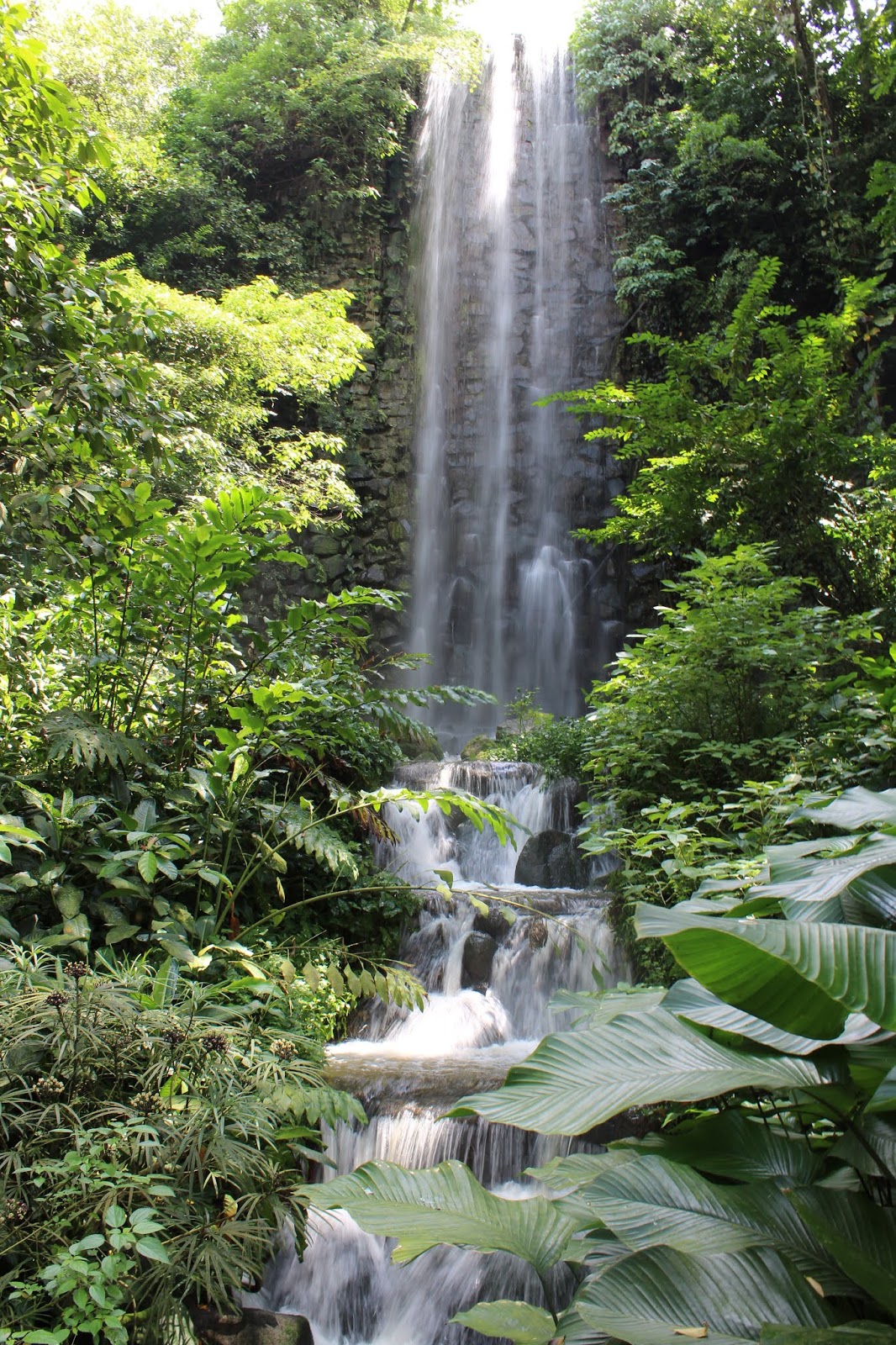
At the top of the loop is an enclosed area with a bunch of small colorful tropical-like birds. After visiting these birds (and the highest manmade waterfall in Singapore), we returned to the pelicans to see them being fed. At feeding time, the pelicans all gather at a tank with a clear side. Staff members tell the audience facts about the pelicans and toss fish to the pelicans so that the birds either catch the fish in their beaks or have to dive. If they dive deep enough, the clear side of the tank lets the audience see how the pelicans’ throat pouches stretch. It’s kind of cool to watch.

Singapore's highest manmade waterfall

Then the other side of the park has large birds, birds of prey, lories, birds of paradise, and toucans/hornbills. The large birds had open enclosures like the flamingos, pelicans, and swans, but a lot of the other birds were in large cages with dense foliage that made it hard to find them. We managed to see a couple of the toucans, and a lot of branches and leaves. On our way back to the entrance, we happened to be at the amphitheater as a show was starting. This show featured some of the smaller parrot-like birds. They had them fly through hoops, there was one that spoke, and a couple of them competed to get balls into a log. After the show, we went out for either a very late lunch or an early dinner before going to the Night Safari.

The Jurong Bird Park’s name is self-explanatory, but the Night Safari less so. The Night Safari is a nocturnal zoo with an animal show, tram tour, and walking paths. Because the animals featured are nocturnal, the Night Safari is only open at night. When we got there, we first watched the show, which included some slightly uncooperative owls, a giant snake, and recycling otters. We next went on the tram tour, which circles the park while a staff member gives commentary about the animals you’re passing. The animals range from larger species like elephants, deer, hippos, lions, tigers, and bears, down to porcupines, owls, and the slow loris. After the tram, we walked a bit to get a closer look at some of the animals and to see some that weren’t visible from the tram. Because it’s night, it can be hard to find the animals at all, but enough of the animals were visible to make it worth going. It’s the kind of attraction that I feel like would be a lawsuit waiting to happen in certain places (i.e. America – it’s dark, people walk around unsupervised, some animals aren’t protected by moats/ballistic glass/electric fences), but it’s safe as long as you don’t do anything stupid, and it’s a unique experience.

Lions at the night safari

Sunday, March 24, 2019

Sentosa – Trick Eye Museum and S.E.A. Aquarium [Singapore 2018]

Singapore, 277 square miles in area (less than a quarter the size of Rhode Island), is already a very small island. Just off its southern coast is an even smaller island, Sentosa (1.82 square miles), a resort island that is now home to attractions including beaches, an adventure park, various museums, and Universal Studios Singapore. Since 2011, you can walk to Sentosa via a ~quarter-mile boardwalk, which is what we opted to do. Out of all the potential attractions, there were a couple that we wanted to see on this trip to Sentosa – the Trick Eye Museum and the S.E.A. Aquarium.

View of Sentosa from the Southern Ridges

We first visited the Trick Eye Museum. Unlike my usual fare of taxidermy, rocks, and vehicles, the Trick Eye Museum contains scenes painted so that you look like you’re in them if you stand in the right place. Some of the scenes have things for you to sit or lie on and some of them require you to take the picture one way, then rotate it afterwards to get the full effect. For example, the photo below has you sit on the bench, then turn it upside down so it looks like you’re hanging from the rafters while being threatened by a giant snake. Other scenes include hanging off a cliff, climbing bamboo, skydiving, being a mermaid, levitating on a chair, horse racing, and being eaten by a friendly fanged fish. The Trick Eye Museum doesn’t have as much repeat visitability as a more traditional museum, but it’s fun, and worth a visit if you’ve never done anything like it before.

Giant snake attack scene

After lunch, we went to the aquarium. However, the bundled tickets we bought to save money (Sentosa FUN Pass) forced us to get to the aquarium through the Maritime Experiential Museum, because otherwise no one would choose to go to the Maritime Experiential Museum. I’m on to you, Sentosa FUN Pass. It’s not a terrible museum; they go through the history of trade between Europe and Asia, a knot-tying station, model boats, and exhibits of some of the major ports and products traded, but compared to Universal Studios and beaches, it sounds like watching grass get cut, which is only a couple steps up from watching grass grow.

The Maritime Experiential Museum connects to the aquarium at the shark tank, and we arrived in time to see the sharks being fed, which was cool. The rest of the aquarium contains the usual mélange of tropical fish, jellyfish, coral, seaweed, that tunnel tank that you can walk through and have fish swimming overhead, schooling fish, small fish, big fish, one fish, two fish, red fish, blue fish. They also have an absolutely giant open ocean tank that takes up an entire room and has an auditorium-sized viewing area. In general, aquariums tend to be expensive compared to other museums and zoos, but if you can find a special deal or bundle the tickets with other attractions, it’s worth it. Timing for the day: about an hour and a half for the Trick Eye Museum, forty-five minutes to an hour for the Maritime Experiential Museum, and close to two hours for the aquarium. So nothing huge like the Field Museum, but more substantial than a state park visitor’s center.

Clockwise from top left: Shark feeding, fish tank, fish tunnel, jellyfish

Open ocean tank

Monday, March 18, 2019

Gardens by the Bay [Singapore 2018]

Next up on the itinerary was an attraction that didn’t exist the last time I was in Singapore. Gardens by the Bay opened in 2012 and consists of outdoor gardens, two conservatories (the Flower Dome and Cloud Forest), and a grove of giant metal trees (Supertrees). We began by taking the MRT (Mass Rapid Transport, Singapore’s rail system, featuring much less rattling, shaking, squealing, and rats than the New York subway) to Bayfront Station. The Bayfront station serves Marina Bay Sands, the shopping center/casino/hotel that looks like it has a spaceship on top of it. Marina Bay Sands was in Crazy Rich Asians and is otherwise famous for the infinity pool on the roof. An MRT station at Gardens by the Bay is planned for 2021, but for now Bayfront is the closest option, so we made our way there and walked the rest of the way to the gardens.

Overview of the Flower Dome and Christmas decorations

The outdoor gardens are free, but the conservatories, where we were headed, are ticketed. We passed through a few of the outdoor gardens on our way to the conservatories, and started with the Flower Dome. Unlike greenhouses that keep plants from freezing in temperate climates, both conservatories keep the plants inside them cool. The Flower Dome contains hundreds of plants, flowers, trees, etc., from non-tropical climates. To attract repeat visitors, they also decorate for different holidays and have a large central area that houses changing displays. When we were there, it was Disney Tsum Tsum themed for Christmas. Since they don’t celebrate Thanksgiving in Singapore, I was subjected to had the privilege of listening to Christmas song remixes/covers the entire time I was there.

Plants

Again, with my vast knowledge of plants, I can say that we saw a lot of them. I know there were olive trees, some orchids, poinsettias and some sort of evergreen brought in for Christmas, and a bunch of cacti. The Tsum Tsums were a fun addition, and I could actually recognize and name them, unlike, say, 99% of the plants I saw.

Cacti

After enjoying the Flower Dome, we moved on to the Cloud Forest. This conservatory’s main attraction is a 115-foot manmade waterfall in a 138-foot also-manmade structure that you can ascend via elevator and descend via a walkway. They try to add educational facts about the tropical mountain climate, cloud forests, environmentalism, and such, but most people are there for the waterfall and the views of Marina Bay.

Cloud Forest waterfall

In total, we took over two and a half hours to see both domes, about an hour and forty-five minutes for the Flower Dome and an hour for the Cloud Forest. By that time, it was too late to do the Skyway walk between the Supertrees, but we decided to stay for the Garden Rhapsody, a fifteen-minute light and music show at the Supertree Grove. If you’ve been wondering what a Supertree is, wonder no longer. The Supertrees are giant metal tree-like structures that are part art installation, part environmental promotion, and part utilitarian. They generate their own power for the light show through solar panals as well as function as giant chimneys for the conservatories’ exhaust and cooling systems. On the night that we were there, the music show was Oldies themed, with songs from the 60s and 70s(?). Overall, Gardens by the Bay feels well-executed. They have a variety of plants in a number of different garden settings, and they manage to make the Flower Dome and Cloud Forest two completely different experiences instead of plants in two different glass domes.

Lighted Supertree

Sunday, March 10, 2019

Southern Ridges [Singapore 2018]

If there’s anything that can almost be considered hiking in Singapore, this might be it. The Southern Ridges is a trail along the – get ready for this – south ridge of Singapore that connects Mount Faber Park to Kent Ridge Park. In between are the Henderson Waves bridge, Telok Blangah Hill Park, Alexandra Arch, and HortPark. After spending the morning at the Botanic Garden with my aunt and cousin’s kids, my mother and I met up with my father at Vivo City for lunch (duck), then started our trek along the Southern Ridges at the Marang Trail at the Mount Faber end and made it to HortPark before going to visit my grandmother and convening with another aunt for dinner. Tired yet? This was day 4 and I had also already seen both grandmothers, met a niece and nephew for the first time, gone to church, met up with family friends for lunch, and survived enjoyed a family reunion with almost all the grandmothers/aunts/uncles/cousins/nephews on my father’s side.

Back to the Southern Ridges. If you didn’t know, Singapore is located one degree north of the equator. It is hot. And humid. Which means that many people prefer the air-conditioned confines of the indoors. I prefer anything that involves a bit of dirt and sweat. The first part of our journey, the Marang Trail, is partially wooded and takes you up to Mount Faber, a whole 106 m high. At the top of Mount Faber, there’s a restaurant/gift shop, you can take the cable car to Sentosa, and you get some nice views of the Singapore architecture.

View from Mount Faber

A walk across Mount Faber Park leads you to the next attraction along the Southern Ridges, the Henderson Waves bridge. The bridge spans Henderson Road and looks wavy, hence the Henderson Waves. The bridge itself (sadly) doesn’t go up and down, but the sides are waves. See below.

Henderson Waves bridge

On the other side of the bridge are the Hilltop and Forest Walks through Telok Blangah Hill Park. According to Wikipedia, Telok Blangah Hill is the original name of Mount Faber, and is Malay for “cooking pot bay,” because the nearby harbor was a – prepare yourselves – bay that was shaped like a cooking pot. The Forest Walk is cool because it’s elevated so you get to walk ~20 feet above the ground through the treetops.

Forest Walk

The Forest Walk leads to Alexandra Arch, a less cool bridge than the Henderson Waves, and HortPark. HortPark is a kind of horticultural center where people can go to buy gardening supplies and see a bunch of themed gardens. And with that, we made our way to my grandmother and on to dinner. Stay tuned for the next multiple-attraction day. Spoiler alert: most days were multiple-attraction days.

Tuesday, March 5, 2019

Botanic Garden [Singapore 2018]

An early excursion was to the Singapore Botanic Garden, the first and only tropical garden to be named a UNESCO World Heritage Site, and also home to the National Orchid Garden. So yes, this post is partially an excuse to show off orchid pictures. I hauled my nice camera across the ocean as my personal item on the plane, and I don’t regret it at all.

At 202 acres, the Botanic Garden is larger than both Nichols Arboretum at the University of Michigan (123 acres), and the Newman Arboretum (150 acres) at Cornell. Similarly to both arboretums, the Botanic Garden contains a variety of different areas, including several lakes (one with a stage for performances in the middle of it), a rainforest, Ginger Garden, Sundial Garden, Children’s Garden, and the Orchid Garden. It’s large (and hot) enough that most areas aren’t crowded; the highest concentration of people can be found at the Orchid Garden.

Swan Lake

When we visited, we started out by Swan Lake, a body of water featuring bird statues, and continued across the lawn to see some big trees. At that point, my cousin’s kids wanted to go play, so my mother and I split off from my aunt and the aforementioned children to go see the Ginger Garden. The Ginger Garden contains over 250 species of ginger. As someone who can tell the difference between a rose and a dandelion, I can say with confidence that the Ginger Garden contained many plants.

Trees, plant, plant, and plant

We reconvened with my aunt/niece/nephew outside the Orchid Garden. To allow us to spend more than 0.1 seconds looking at each orchid, we arranged to meet up with them again after going through the Orchid Garden. Even if you don’t fully comprehend the horticulture required to breed/grow/cultivate orchids, the sheer scale of this garden is impressive. There are thousands of orchids from dozens of different varietals/hybrids in all sorts of shades of red, orange, yellow, pink, and purple. Kind of like how the peony garden at the University of Michigan arboretum blooming every June is a Big Deal, the orchid garden is a Big Deal, except year round.

Orchids

Thursday, February 28, 2019

Singapore 2018

Back in November, I took my first big trip in years to visit extended family in Singapore. I was out of the office for over three weeks and to make up for the vacation time, worked through Christmas and New Year after I returned to Ann Arbor. A large part of the trip was seeing (and meeting) family, but since it was my first time back in Singapore in close to fifteen years, we also did a lot of the touristy things. The goal is to get everything written and posted before summer.

I started my journey to the other side of the world by flying home to New England for a couple days. We had just gotten new music for concert band, so I ran through it before leaving. I ended up missing three rehearsals and didn’t have a chance to practice while I was in Singapore, but managed to catch up before the concert because we happened to have ten rehearsals between our first and second concerts of the season. We’re preparing for our third concert and started out with six rehearsals, but the first got cancelled by snow, so we’re down to five weeks to prepare.


Hong Kong airport

The first leg of our flight was fifteen and a half hours in the air to Hong Kong. The only way to describe this is long. Everyone boards, they make the safety announcements, the plane taxis, takes off, you settle in, they feed you a meal, you take a nap, see a couple movies, and check your watch. You’re only eight hours into the flight and you still have that long to go. But overall, the flight was fine. The food was edible, though the eggs were not quite right. I watched Ready Player One and the Shaun the Sheep movie and rewatched Big Hero 6. Ready Player One was okay. They changed basically all the details and only used the general plot, but it made sense in the context of reading vs. watching.

We landed in Hong Kong in the morning with enough time to eat before catching our connecting flight. After our snack(?)/breakfast(?)/dinner(?), we found our gate and boarded the plane for the last three and a half hours to Singapore. We were fed second breakfast at lunch time (more questionable eggs) and I rewatched Zootopia. And then we landed in Singapore, went through immigration, claimed our baggage, and were greeted by family. Before we left the airport, we had another undefined meal (the first of many), then we stepped out into the hot, humid embraces of the Singapore weather. We had arrived.