Tuesday, May 17, 2022

All About Birds

Despite telling myself that I would not start crawling around in the bushes looking for nuthatches and titmouses (titmice?) or become one of those people they make movies about, shortly after getting my telephoto lens, I started trying some bird photography. Wildlife is generally regarded as one of the more expensive genres of photography to get into, because it’s an area where you do really need the reach of a long telephoto, and super-telephotos aren’t cheap. I sacrificed an extra 50 mm of zoom to avoid Canon’s most-hated 75-300mm lens in favor of the 55-250mm, which gives me a maximum focal length of 250 mm (400 mm full frame equivalent).

So far, hiking-liteTM through suburban/urban park areas where birds are abundant and somewhat used to human activity, I’ve found 250 mm is enough for large birds like swans and geese, and is okay for smaller birds if you’re a little patient and/or very quiet. Beyond 10 or 20 feet away, though, small birds start turning into little blobs, which is why it’s not uncommon for wildlife photographers to be looking for lenses with 500-600 mm focal lengths, at minimum. I started out in winter when I knew a lot of ducks and geese would be hanging out on the Huron River at Gallup Park. There I saw hoards of Canada geese and mallards, plus some trumpeter swans and a pair of hooded mergansers. Also a northern cardinal and some potential vireos (maybe warbling vireos, but they’re not supposed to winter in the north) trying to stay warm in the trees along the shore.

Hooded merganser (male)

Unidentified vireo-like bird

As spring came to Michigan, a lot of the smaller songbirds returned. There’s one spot in particular that has tons of birds and I’ve seen a number of actual birdwatchers there. I’ve so far managed to identify a great blue heron, more mallards, a bunch of hooded mergansers that spent a couple weeks there, lots of red-winged blackbirds, some blue jays and cardinals, plenty of American robins and grackles, a pair of mourning doves, a yellow-rumped warbler, a yellow warbler, and possibly a northern waterthrush. On a trip to the arboretum, I found a couple downy woodpeckers and a red-bellied woodpecker. There’s also the Cooper’s/sharp-shinned hawk I saw once before I had my telephoto lens.

Great blue heron

Grackle

Besides all these, I’m sure there are dozens of other species I haven’t managed to recognize, and I probably should get better at identifying bird calls. Most of the identifications so far come courtesy of the Cornell Lab of Ornithology’s All About Birds website and a lot of scrolling through bird pictures. Until next time; I’ll be back to hiding in the brush wearing out my shutter. Remind me to start doing tick checks again. I don’t particularly need or want Lyme disease.

Red-bellied woodpecker

Tuesday, May 10, 2022

Sensor Showdown

I previously wrote about camera sensors – how they work, sensor size, and a comparison of various sensors in cameras that I’ve owned plus a couple that I haven’t. What I didn’t do there was directly compare photos from my cameras. I suspect that at web publication size it’s going to be difficult to tell the difference, but let’s find out.

I found a couple pairs of pictures among my thousands of photos of similar, though not exactly the same, scenes, taken by 1) the Fujifilm FinePix XP55 (point and shoot) vs. the Canon Rebel T6 (APS-C DSLR) and 2) the Samsung Galaxy Orbit J3 (my mostly functioning phone) vs. the T6. To compare, I’ll be showing both the full photo and some crops at 100%. Normally you don’t zoom in to 100%, because 18 or even 12 MP is plenty for the majority of applications, especially scrolling through social media on your phone, but for the purposes of this exercise we’re doing it.

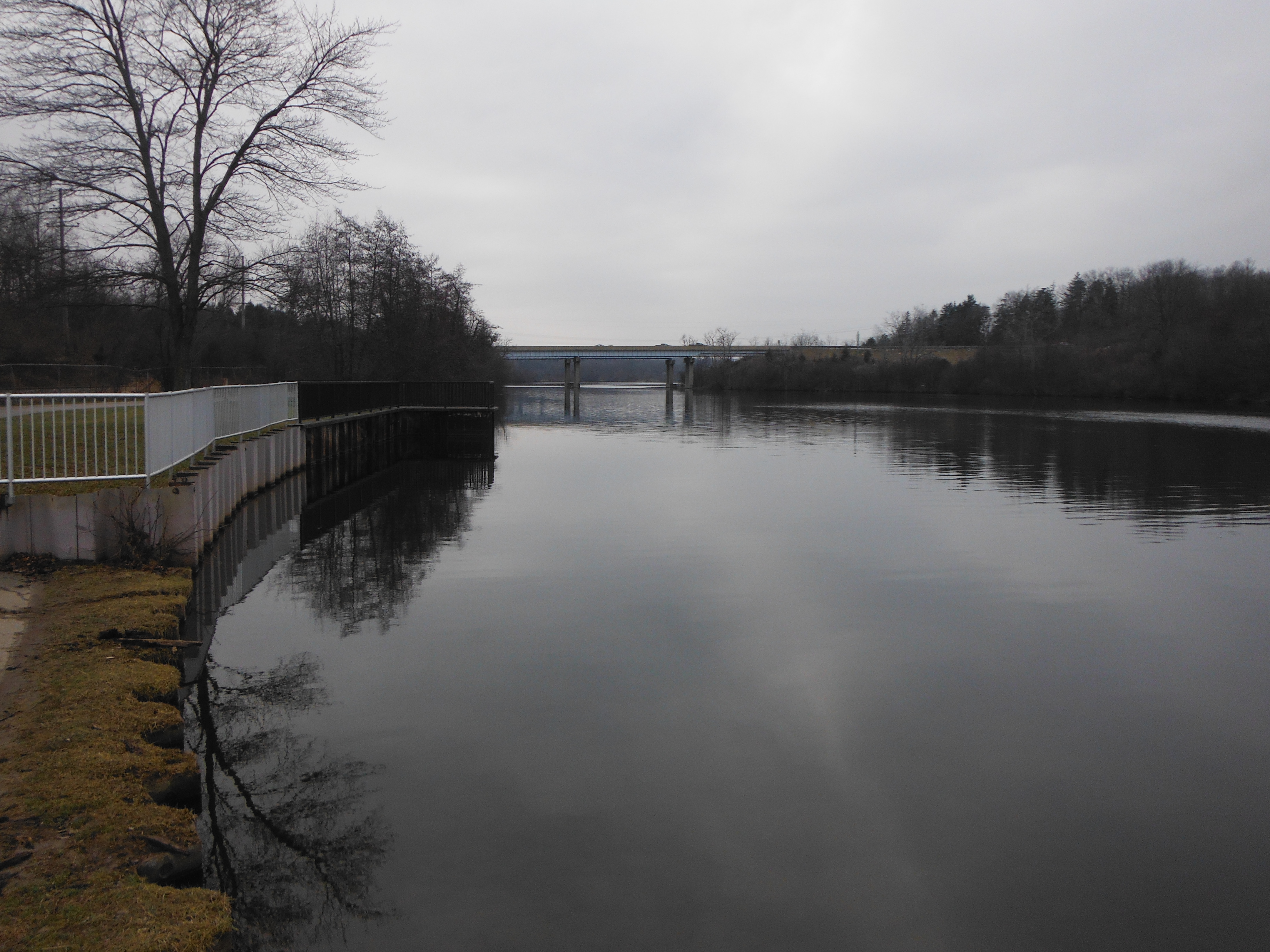
First up, we’ll look at the Huron River at one end of Gallup Park on the Border to Border Trail. The point and shoot picture was taken on the last day of 2021 when I was taking advantage of 40 degree (F) weather to go for a bike ride. The DSLR photo was taken on the first day of February when it also hit 40 F but we’d had enough cold weather to partially freeze the Huron and there was some snow on the ground. So obviously the conditions were different, but the framing is very similar (the 35mm/full frame field of view equivalents1 are 28 mm and 28.8 mm for the XP55 and T6 respectively, so essentially the same). In terms of the other settings, the XP55 used a larger aperture, but with such a short focal length more or less everything is in the range of acceptable focus. With the T6 at f/8 and focusing on the bridge in the background, the depth of field extends to all the way from infinity up to a couple meters in front of me. Both shutter speeds should have been fast enough to avoid camera shake, and the ISOs were the same.

Fujifilm FinePix XP55, 5 mm, f/3.9, 1/150 s, ISO-100

Canon Rebel T6, 18 mm, f/8, 1/100 s, ISO-100

Overall, I think the T6 photo is sharper, and it retained better texture in the sky, which could have been because of the different weather conditions, but I would expect the T6 to have a better dynamic range (the maximum different between light and dark areas that a camera can capture in a single exposure – for the T6 it’s 10 stops; the human eye sees about 21 stops) than the XP55. If we zoom in all the way, the front tree is decidedly sharper on the T6, and if we look at the railing section, the T6 photo is both sharper and less noisy.

XP55 (left) vs. T6 (right)

Next I have a couple photos from separate trips to the library. Again, the T6 photo is overall sharper, which can be seen if I zoom in all the way and try to read some of the book titles. It’s not hugely obvious in the crops below, which proves my point about web resolution. The other part of the photo where the T6 looks sharper than my phone is actually the overhead light fixture. Again, not super obvious below, more obvious on my computer at 100%. The one point that the phone comes out ahead on is its significantly larger aperture that lets in something like 8 times (3 full stops) as much light as the maximum aperture on my DSLR’s wide angle lens, allowing for a much lower ISO. It’s not as noticeable around the books, but I can kind of tell zoomed in to some of the areas that are more monotone in color that the DSLR photo is noisier.

Samsung Galaxy Orbit J3, 3 mm, f/1.9, 1/40 s, ISO-125

Canon Rebel T6, 18 mm, f/5.6, 1/60 s, ISO-1600

Phone (left) vs. T6 (right)

To conclude, yes, a sensor with a 10-30x greater area outperforms a ten year old point and shoot and a Tracfone. However, unless the photo is obviously not in focus (quite possible with my phone photography), you may not be able to tell online, and probably not with small prints either. Where people would be able to tell in practical applications (i.e. not zoomed in at 100% on a computer looking at individual twigs on a tree) is with cropping and larger prints. Lugging around a DSLR is worth it for me for the improved low light performance, ability to change camera settings, and intentionality of framing a photo, but if you only ever look at photos on your phone and rarely print anything, you can probably save your back and your wallet with a halfway decent phone.

1Crop factor can get confusing, but the relevant information here is that it’s based on sensor size compared to the “standard” 35 mm or full frame format. The T6 has a crop factor of 1.6 and the XP55’s 1/2.3” sensor has a crop factor of 5.6 so that focal lengths of 18 mm and 5 mm respectively give the same field of view as a 28 mm lens on a full-frame camera.

Saturday, April 30, 2022

Sense and Sensor-bility

While I was looking things up for my post about how I ended up with the Canon Rebel T6 and my lens trifecta, I also got sucked into finding out about camera specifications, which led to camera sensors. Turns out it was a bit of a rabbit hole.

To start, digital camera sensors are the equivalent of film in analog cameras. They capture light and record color to reproduce images. Older digital cameras often used CCD (charge coupled device) sensors, but they’ve since been replaced by CMOS (complementary metal oxide semiconductor) sensors. Both types of sensors rely on photosensitive semiconductors that convert light into electric charge. The charge is then converted into voltage, and the correlation between light (brightness) and voltage can be used to recreate the photograph. CCD sensors are analog devices that send the charges from each semiconductor through an output node to be transformed into voltage while CMOS sensors convert charge to voltage at each individual pixel. While CCD sensors were originally the sensor of choice because of their low noise, CMOS sensors are cheaper and require less power, and technological advances have improved image quality to equal or better CCD sensors.

For color photography, a color filter array sits on top of the sensor. Commonly used in digital cameras today is the Bayer filter, which contains RBG color filters arranged in a checkerboard-like pattern on the pixel array of a sensor. The Bayer filter has 50% green filters, 25% red filters, and 25% blue filters, which reflects the physiology of the human eye. Because each pixel now only sees either red, blue, or green, the image needs to be processed with a demosaicing algorithm to give each pixel RBG values. For example, a green pixel has its green value measured directly, then can get its red and blue values by interpolating from its red and blue neighbors.

At the library
[Samsung Galaxy J3 Orbit, 3 mm, f/1.9, 1/40 s, ISO-125]

Finally, on to sensor size. In filmmaking and film photography, 35 mm film was the most commonly used film size, so when digital cameras became a thing, a sensor size that matched 35 mm film – 36mm x 24mm – became known as “full frame.” In general, bigger sensors/film require bigger lenses/cameras that are more expensive, so camera manufacturers also came out with so-called “crop sensor” or “APS-C” cameras with sensors typically sized at 22.3mm x 14.9mm (Canon) or 23.5mm x 15.6mm (every other brand). Then there’s the Micro Four Thirds System, 1-inch sensors, and once you get smaller than that (as in a lot of point and shoot/phone cameras), sensor size is usually expressed as something like 1/2.3”. This number ostensibly refers to the diagonal of the sensor, but it’s based on old video camera tubes, which were sized based on outer diameter, not usable inside area, so a 1/2.3” (0.435”) sensor actually has a diagonal of around 0.3” and dimensions of 0.24” x 0.18” (6.17mm x 4.55mm).

Argo Park on the Border to Border
[Fujifilm FinePix XP55, 7 mm, f/4.3, 1/58 s, ISO-100] 

Once you have your sensor, you then divide it into thousands of areas that each correspond to a pixel. The bigger a pixel is, the more light it individually captures, and the better it can capture whatever you’re photographing. For example, the Fujifilm FinePix XP55 has a 1/2.3” sensor and a resolution of 4320 x 3240 so has a pixel size of about 1.4 microns on a side (6.17 mm/4320 = 1.4 microns). My Rebel has the Canon APS-C sensor and a resolution of 5184 x 3456, giving a pixel size of ~4.3 microns. So even though the megapixels aren’t that different (4320 x 3240 = 14 million pixels, or 14 megapixels vs. 5184 x 3456 = 18 MP), the larger sensor and pixel sizes mean improved picture quality.

Tree at sunset
[Canon Rebel T6, 55 mm, f/8, 1/160 s, ISO-100]

Out of interest, I tabulated the specifications for a number of cameras I’ve owned below. The top of the table (click to enlarge) is digital cameras and the bottom is phone cameras. For fun I included Canon’s current most expensive professional mirrorless camera, the R5, which at $3899 for the body alone I don’t anticipate owning any time soon, if ever (I’ll be holding out for a mirrorless crop sensor R-mount camera for when I need to replace my T6; the current APS-C mirrorless line uses a different lens mount with few native lenses and like Canon’s entire range of DSLRs and lenses, seems to be a developmental dead end.). I also put in Apple’s latest and greatest offering, the iPhone 13 Pro, for comparison with my phone, which cost about the same as a pair of Airpods.

I was surprised by a few things, and unsurprised by others. First, I didn’t realize that my DSLR didn’t have many more megapixels than the FinePix XP55 or even the PowerShot SD1300. The sensor size, however, is over 11 times larger in area, and jumping up to a full frame sensor, though it doesn’t look massively larger, still more than doubles sensor area. On the flipside of things, I think I’m justified in my dislike for my phone camera, which at best has a sensor less than half the size of a 16-year-old digital camera. And even though one of the most advanced iPhones has surpassed my more recent point and shoots in sensor size, that sensor is still less than a sixth of the size of my entry level DSLR’s, which is one reason why people still pay hundreds and thousands of dollars for DSLRs and mirrorless cameras.


1My phone camera (unsurprisingly?) not only has microscopic sensors, but also non-standard size sensors, so the inch equivalent is approximated from the sensor dimensions.

2I couldn’t find the aspect ratio for the iPhone’s sensor, but it’s stated to be a 1/1.65” sensor, so those are the approximate sensor dimensions and resolution based on a 4:3 aspect ratio and the given megapixels. Calculations are for the iPhone’s best (largest sensor/most megapixels) camera.

Monday, April 25, 2022

Project Recap [misty mountains]

The latest big project I completed was for no one in particular. I liked the pattern when I saw it, it was on sale, and it didn’t require too many colors, so I ended up picking up the thread for it when I went shopping for the supplies for my previous two projects (the monarch butterfly and sunset lake).

The (untitled) pattern was drafted by ZephyrMood and I purchased it on Etsy. There were ten colors, with only one color needing more than 1 skein if stitching on 14 count aida with two strands. It was a full coverage pattern, all full cross stitches with no backstitching or specialty stitches. Not a whole lot of confetti stitching to speak of, and enough color blocks to mostly work tree by tree at the bottom and by horizontal layers in the mountains.

Fog on mountains and trees

The circular pattern measures 112 x 112 stitches, or 8 inches in diameter on 14 count fabric. My unwashed project measures about 8 1/16” wide and 7 7/8” high, so slightly off like all my other projects, but not noticeably uncircular. Based on the area of a circle, the stitch count is somewhere north of 9800 stitches, though the sum of the given stitch counts for each color in the pattern is 9715. I started right after Christmas and finished a few days after Valentine’s Day, for a total elapsed time of 55 days, an average of ~180 stitches per day, though I didn’t work on the project every day. At this time in real life, it was after I defended, then before/after my final thesis submission, when my brain appreciated taking a break from micelles and margin formatting. I currently don’t have the supplies for my next project, so I’ve turned to the library to start going through Terry Pratchett’s works and RNG-ing my way though a long list of sci-fi and fantasy titles.

This pattern was based on a watercolor work by another Etsy seller, AquarelleSpace. One of the problems with some of the pattern mills that have popped up is that when they make patterns by running photos and artwork through pattern generating software, the resulting patterns can sometimes be not great, with excessive confetti and random colors with two or three stitches in the entire pattern. That was not the case here, and I thought it was a good adaptation of the original watercolor. The only negative was that there’s no stitched model on the Etsy page, so the colors in the mockup don’t exactly match the floss colors in real life, but I still think the finished project turned out well. I worked off the 1 page tablet pdf version of the pattern, with the symbols over colored squares. Symbol choices were reasonable and the pattern was easy enough to read. Overall, a solid pattern, I like the final result, and even the top however many stitches done entirely in 3865 weren’t too bad with a YouTube video or podcast running in the background.

Tuesday, April 19, 2022

Winter

After returning from the Upper Peninsula, as I mentioned in my yearly post, I jumped into speed writing my thesis before defending right before Christmas, then final thesis revisions were due in January. In between all that, I generally carried on as usual with life in Ann Arbor. It wasn’t a particularly cold or snowy winter, so I got outside when I could, including biking through the winter months. Right after Thanksgiving, I got my telephoto zoom lens, so I also spent time crawling through the undergrowth looking for squirrels and birds.

Squirrel

Early in December, I paid a visit to the arboretum to try out my telephoto lens. Around that same time, the public golf courses run by Ann Arbor Parks and Rec open up to walkers/dog walkers/etc. by inverse rule – from March to November, non-golfers are explicitly not allowed to be on the golf course, but if it’s not March to November, they’re not not allowed. I’ve mostly been walking in the same circles for the past two and a half years, so the golf course is a nice variation and it gives the golf course purpose in the winter.

Golf course cloud at sunset

I also continued on my other usual paths. The ornaments were out again this year in one of the parks I frequent, and I found some new additions. The week before Christmas, Ann Arbor got freezing rain, and I made a loop around my neighborhood to get photos. Between Christmas and New Year’s, a coworker and I made a trip to the botanical garden when the weather was too nice to stay inside. The indoor conservatory had reopened by then, and had a couple Christmas trees plus an “art” exhibit where they put frames around some of their plants to highlight different design principles used in art like color, space, texture, etc.

Some sort of Christmas rodent

Christmas tree at the botanical garden conservatory

With my bike in action and a telephoto lens in hand, I headed to the Huron River a couple times in January because from prior years I knew that a lot of ducks/geese/swans gather along the shores of the Huron during winter. It was mostly mallards and Canada geese, but also some trumpeter swans and once I saw a pair of hooded mergansers. With the weather holding through January, I biked my new telephoto lens out to the Barton Nature Area as well, but arrived in time for the sun to be setting directly over the river, so didn’t get a whole lot with it.

Barton Dam

February finally stayed cold enough any snow we got to stick around for a while. One day, we were getting a good amount of soft, fluffy snow, the kind that sticks to branches if there’s not too much wind, so after work I headed out with my camera. Mid-February, there was one warm day that I took my bike out on the Border to Border trail. The B2B, at least the sections that go through the major parks, does get snow removal services during the winter, so that was clear. Once I got to the Parker Mill Park section, it was slushy, but passable with my all-purpose Target children’s bicycle. Then I got a look at the Matthaei Botanical Gardens Trail, and somewhere in the back of my mind I think I did remember it falls into the university’s “no winter maintenance” category. The MBGT was essentially melted water over hard packed snow/ice, in other words, very slippery. At that point I decided it was not a good day to die, so I turned back there.

Snow on trees